
Boxing betting odds in Great Britain, priced from the inside out
 Available in US
The price the bookmaker publishes is the only number a punter can see on the slip. Everything else — the margin the firm keeps, the size of the overround, the shape of the favourites on a major card — sits inside that single decimal or fraction and tells the sharper reader where the value has gone. Boxing is a useful place to study the trick, because the sport runs on a small number of well-defined outcomes (win, lose, draw, method, round group) and the books slice those outcomes into dozens of markets per fight. The numbers the firms print, the methods they use to withdraw the juice once a bet is in, and the rules that decide whether a winning slip is actually settled all come together to define what a betting price on boxing is, in Great Britain in 2026.

The aim of this guide is plain. Walk through how a price on a boxer is constructed in the first place, what the available markets look like across a fight card, which licensed bookmakers carry the deepest boxing product in Britain, and what the rules and protections are when a real stake meets a real market. The Trading desks work to a margin the slip doesn’t show; this page is about reading that margin, picking the right marketplace for a punt, and understanding the mechanics before the first round is thrown.
Standfirst: prices current as of October 30, 2026, verified against the Gambling Commission’s public register and each operator’s own published terms.
Where boxing betting sits in British law
There is no list of sports a British bettor is allowed to wager on, and there is no statutory list of permitted markets either. Boxing sits inside a regulated commercial market rather than a privileged corner of it. The Gambling Act 2005 — and the Gambling (Licensing and Advertising) Act 2014 that extended it — sets the framework: any operator whose remote facilities are used by customers in Great Britain needs a Gambling Commission licence, no matter where the operator is incorporated. A Curaçao, Maltese or Gibraltar licence is not a substitute; offshore brands that serve British customers without a Commission licence are operating illegally at the point of consumption, and that is a long way from a consumer-protection nicety.
The wider frame matters because boxing is one of the small number of sports where a single event can move a market on its own. A late injury, a weigh-in controversy or a changed corner pulls prices violently, and a betting exchange with thin liquidity magnifies the swing. British regulation doesn’t try to stop those moves; it tries to make sure the firm on the other side of the bet is solvent, monitored and accountable. The Commission’s public register is the test of who holds a licence: a brand is either there, with a current operating licence, or it isn’t, and the slip a punter fills in at an unlicensed site has no recourse if it isn’t paid.
That licence lookup is the single most useful act of due diligence a British punter can do before opening an account, and it is also the one that gets skipped most often. A search by business name, trading name or domain returns the licence number, the licence categories held, and any conditions or active regulatory action against the holder. The categories include general betting standard for real events, which is what every sportsbook on this page holds, plus betting intermediary for the exchanges and separate categories for pool betting or virtual events. A licence to take bets on a real boxing match is a general betting standard licence; an exchange that matches back and lay bets between customers is a betting intermediary, and the cash side of an exchange also has to be authorised under money-laundering rules.
A related licence is the one Spreadex holds, partly under the Financial Conduct Authority rather than the Commission alone: financial spread betting is regulated by the FCA, and spread betting losses can exceed the deposit in a way that ordinary fixed-odds betting does not. That’s a separate frame for a separate product. The rest of this page is about fixed-odds sportsbooks and betting exchanges licensed by the Commission.
The age and identity rules the Commission enforces apply to boxing as to every other sport. Eighteen is the minimum age for any gambling product. Identity, address and date of birth are verified before the first deposit or the first stake, including when the only money at stake is a free bet or bonus credit. A punter who can’t or won’t pass those checks simply doesn’t reach the betting slip; a punter who can is on a regulated site where the account is tied to a verified identity and every deposit and withdrawal is logged.
The licensee’s continuing duties matter for boxing in two ways. Licensees must offer GAMSTOP self-exclusion across the regulated market, and they must follow the Licence Conditions and Codes of Practice on social responsibility, with the operator’s own risk assessments on top. Punters using a licensed site have, beyond a settlement dispute route, an approved alternative dispute resolution service and the Commission’s own complaints procedure if a firm doesn’t pay; an offshore operator offers none of those.
Safer gambling tools in the boxing market
Boxing has a particular risk shape that betting controls try to address. It is a sport of long lay-offs and short, intense bursts: a title fight happens every few months, the market builds for weeks, then a single twelve-round contest settles a card in one evening. Most weeks on a boxing calendar carry no title event at all; the weeks that do carry carry an outsized share of the year’s staking volume. The same intensity hits the punter who watches a card, sees a flurry of knockdowns, and tips more on the next round than the bank was sized for.

The first defensive line is GAMSTOP, the national multi-operator online self-exclusion scheme every GB-licensed site has run since March 2020. Self-exclusion can be set for six months, one year, five years or five years with auto-renewal, and once the minimum period is up the exclusion stays in force for a further seven years unless the customer asks GAMSTOP to remove it. Coverage is for online sites and apps; betting shops are governed by a separate in-shop scheme.
The second line is financial. A light-touch public-records check fires once a customer’s net deposits over a rolling thirty days cross £150, and it looks for entries such as bankruptcies or county court judgments — not income and not a credit score. A heavier financial risk assessment sits further along the operator’s own process, with a Commission framework announced but staged and no start date attached. There is no state-set ceiling on what a punter can deposit or lose; the deposit limit is the customer’s choice, and operators must offer a gross deposit limit over a fixed time frame, with new rule phases running through late 2026.
Help lines and counselling are part of the regulated landscape, and a licensed operator’s safer-gambling pages link out to them. GamCare runs the National Gambling Helpline, GambleAware funds treatment, the NHS runs gambling clinics in several regions, and Gamblers Anonymous runs peer meetings. These routes are open to anyone — they aren’t a licensed-only product — but a licensed site is required to advertise them and trained staff can signpost a customer to one. An offshore site carries no such duty and no such signposting.
A clean read of the trade-offs: a licensed site means identity checks before a stake, automatic GAMSTOP if self-excluded, the £150 check that catches one obvious class of harm, and a regulated complaints process if a settlement goes wrong. An unlicensed site has none of those, with the additional risk that withheld funds and refused settlements have no recourse path on this side of the Channel. The protections aren’t free — verification is a wall that some customers find irritating — but the alternative is to bet into a market with no British redress at all.
Crypto, anonymity and the licensed UK market
The Commission’s rules close off a different doorway at the same time. There is no anonymity at a licensed British bookmaker, because the first bet requires a verified identity and a verified payment method. That is true even where the only stake on the table is a free bet or a few pounds on a Friday-night undercard. The same identity holds across every Commission-licensed site, since the verification data is shared across operators for the purposes of GAMSTOP and of preventing multiple accounts being run by one self-excluded or sanctioned customer.
Cryptocurrency has no statutory ban at the licensed operator, but the licensed operator’s own onboarding rules make it functionally unavailable: a deposit in bitcoin or ether has to be sourced and the source verified, and a withdrawal has to settle to a verifiable account in the customer’s name. Operators can, and many do, refuse crypto outright, with the rationale sitting inside their own anti-money-laundering policy rather than the Gambling Act. There is no licensed British sportsbook that openly advertises bitcoin or litecoin deposits in 2026, because the verification flow that licensing imposes is incompatible with the pseudonymity that crypto aims to provide.
The crypto-friendly landscape, in fact, lives almost entirely outside the Commission register. A punter looking for bitcoin deposits on a boxing market is led to offshore operators holding a Curaçao or Anjouan licence, by affiliate sites that describe those operators without ever quoting a Commission account number. The trade-off is well-rehearsed: a crypto-funded offshore account means no GAMSTOP coverage, no Commission complaints route, no approved alternative dispute resolution body, and no British consumer redress if the firm refuses to pay. The crypto transaction itself is reversible in some directions and irreversible in others, and the firm’s compliance team holds the only leverage over a disputed withdrawal — a position no British licensed punter is ever put in.
The clearest framing: a crypto deposit at a British licensed bookmaker is, in practice, a debit-card deposit — the currency is tokenised, but the customer’s identity and the source of funds are checked identically. A crypto deposit at an offshore bookmaker is, in practice, an unregulated stake with no Commission recourse. Neither route is anonymous in the way a punter looking for anonymity might imagine; one is a regulated transaction with a token veneer, the other is an unregulated transaction with no veneer at all.
Welcome offers, free bets and what they really cost
The welcome offer is the first thing a punter sees on a bookmaker’s home page, and it is also the most over-marketed line on the page. A “free bet” can read like free money, but it never is. The terms distinguish offer types sharply, and the type decides what the offer actually costs the customer and what it returns.
A free bet is a token the operator credits to a winning slip’s account; the stake itself is usually not returned with the win. A £10 free bet on a 4/1 winner pays out the winnings on the £10, not the £10 plus winnings — so the punter collects £40 rather than £50, and the operator has paid out less than the headline number implies. The free bet can also come with a cap on what it wins, a minimum odds requirement the qualifying selection has to clear, a deadline before it expires, and often a list of markets it cannot be used on. Read the terms, and the free bet reads differently.
A price boost is a one-off enhancement of an existing price on a named selection, often a heavy favourite. The stake is paid normally and the winnings are paid at the boosted price; the operator is offering the customer a sweetener on a price it would otherwise have laid. Boosts usually have a maximum stake and a maximum payout, both of which can flatten the headline number very quickly.
An acca insurance or accumulator refund refunds a losing stake as a free bet or bet credit when one leg of a multiple lets the rest down. Stake returned is similar in shape, except the original stake is matched against a promotion that requires a specific bet type, often a treble or larger, and the refund is issued only when that specific bet loses. Hollywoodbets, for instance, runs the shape on accas of three or more legs at minimum odds of 4/1, with the stake returned as a free bet of up to £30 on the first qualifying loss and one free bet per customer.
A deposit-gated offer requires a deposit of a specific size and sometimes a qualifying bet at minimum odds before the credit is paid out. Unibet’s sports welcome offer credits £40 in free bets once a deposit and a sports bet of £20 or more at minimum odds of 2.0 (1/1) have settled, with the free bets expiring seven days after issue; a debit card or instant bank transfer is the eligible payment method. Coral’s terms are close to identical on the headline number, with the same minimum-odds trigger and the same seven-day window. BoyleSports, addressing Irish as well as UK customers, prices both sterling and euro versions of the same idea: £20 in free bets on a £10 bet, or €30 in free bets on a €10 bet.
A matched deposit bonus gives the customer a percentage of their deposit in bonus credit, with that credit then subject to a wagering requirement before it can be withdrawn. Wagering requirements on bonuses are capped by Commission rules: a £10 bonus at 50x needs £500 of qualifying bets to clear; under the cap no more than £100 of qualifying bets can be required. The cap changed the shape of welcome packages at every major firm in 2026. A bonus with no wagering condition attached — typically a price boost or a free-bet offer — is not constrained by the cap.
Mixed-product promotions are no longer allowed at all. From 19 January 2026, an offer that requires the customer to gamble on two or more product types — betting plus casino, betting plus bingo, betting plus lottery — was banned outright. So a “bet on boxing to get free spins” type welcome package has gone the way of the dodo, and the current welcome packages across British-licensed sportsbooks stick to single-product mechanics.
The arithmetic behind a clearing offer is closer to a slot-machine calculation than to a sports calculation. A bonus of £10 with a wagering requirement of 5x, placed entirely on boxing markets at an average margin of, say, 6%, costs the punter roughly £3 in expected margin over £50 of qualifying bets; with a free bet of £20 at minimum odds of 1.5 (1/2), the expected value before settlement is close to £10 of upside with the stake not returned. Two numbers the punter should always know about an offer: the amount of credit on offer and the wagering multiple, in that order. If either is missing from the headline, the offer is being sold rather than described.
Best Odds Guaranteed sits in a slightly different slot. The bookmaker guarantees that if the starting price at the off is bigger than the early or show price taken, the bet is paid at the SP. On British and Irish horse racing, the rule has been a market standard for years, and William Hill offers it from 8 AM on the day of the race on both singles and multiples, with no coverage on ante-post, tote or pari-mutuel bets. Bet600 publishes the same rule on horse racing. On boxing, BOG is rare — the sport doesn’t have a starting price in the same sense, so the rule is mostly a horse-racing benefit and a useful side feature on multi-sport accounts rather than a boxing attraction.
Football acca boosts cross over from time to time. William Hill runs a Football Acca Boost on accas of two or more legs, with each selection at 1/5 or bigger, scaling from a 3% boost on a double to a 200% boost on twenty or more legs, with a maximum boost of £10,000 per online bet. The promotion is football-specific, but a punter who keeps an accumulator alive across sports can sometimes stack an acca leg from a boxing bout into a multi-sport ticket, and the boost applies to the whole ticket where the legs qualify.
Mobile and app experience on boxing nights
The British boxing calendar is uneven. Some weeks hold nothing beyond low-tier club cards; some weeks hold a heavyweight title fight, pay-per-view boxing and a sold-out stadium of watch-along pub trade. A punter’s app has to work in both cases — through the slow weeks of form study and through the dense nights when the markets reopen between rounds.
The big-name British books are app-first products. bet365’s app is, by its own description, the most downloaded sports betting app in the UK; Betfred’s app covers twenty-one sports including boxing; Unibet’s UK app has been live since 1999 at company level; BoyleSports’ sports betting app and DragonBet’s app both publish through the App Store with the relevant UK age ratings. The apps vary in cover, in market depth and in how quickly a price refreshes after a knockdown, but the operational ground is the same: a login, a search, a coupon, a stake input, a confirm.
Bet Builder has migrated from football to boxing on the bigger books. The basic mechanic takes several markets from one event — method of victory, round group, total rounds, go the distance — and folds them into a single price. bet365’s Bet Builder+ covers exactly that workflow across single events, with a Super Boost and a Winning Boost on selected singles and bet builders layered over the top. Matchbook’s betting exchange runs an analogous bet builder; DAZN Bet’s product is a fixed-odds bookmaker with the same multi-market feature set.
Live streaming is where boxing apps diverge sharply from football apps. Most bookmakers stream horse racing, greyhounds, and selected football matches, but very few stream professional boxing under a UK rights deal; the high-profile fights are split between Sky Sports, TNT Sports, DAZN the broadcaster, and the BBC for some amateur bouts. An app’s live-streaming lineup at fight time is more often a pool of football and US sports than a feed of the undercard; the price updates from the live in-play markets are the live product on boxing, and the visual coverage sits with the broadcaster. The exception is the Matchbook exchange, which streams horse racing and greyhound racing on top of its in-play betting, and which doesn’t stream boxing at all.
Deposits at the licensed shops run through a small set of payment methods: debit card, Apple Pay, Google Pay, Paysafecard, Trustly, Skrill, PayPal. DAZN Bet’s own help pages quote a minimum deposit of £5 by debit card, Apple Pay, Paysafecard, Trustly and Skrill, with PayPal starting at £20, and no processing fees. Credit cards are banned for gambling in Great Britain, including credit-card-funded payments through an e-wallet, which closes off one corner of the market by force. Cryptocurrency is not on the menu at a licensed firm.
There is no statutory withdrawal time. Each operator sets its own, with debit-card withdrawals often running on the same day or the next working day, bank transfers running 1-3 working days, and e-wallets typically faster than cards. Fast withdrawals are a feature some firms use as a marketing hook, and the timing on a single withdrawal of £200 is a reasonable proxy for what the firm does at stake time, but the speed on a routine withdrawal is rarely the limit on a punter’s evening.
A licensed British bookmaker will look like a regular modern betting app: a homepage with featured events, a search, an in-play tab, a bet builder, a bet slip, a banking screen, a safer-gambling page. The features that vary most are the boxing market depth (a smaller firm may carry only winner markets on a low-tier card), the in-play latency (refresh speed on prices), the live-streaming rights (mostly small for boxing), and the welcome offer (a sweeping topic the prior section covered). Beyond those, the apps are interchangeable at the surface and distinct only in how their trading desk sets a price.
In-play boxing and cash-out mechanics
In-play betting is the centre of gravity of a boxing betting evening, and it is also the part of the product most exposed to the operator’s house rules. Unlike pre-match markets, where the price is broadly symmetric across firms and arb-friendly in the limit, the in-play market resets after every bell, and the offer to cash out a position at a struck price sits at the discretion of the operator.
The basic in-play product is a small menu of markets that refresh on a routine: fight winner, method of victory, next-round winner, fight to go the distance, total rounds over/under. Prices move sharply on each knockdown, with the operator often suspending the market for one or two refresh cycles while the ringside medical team works. A punter who clicks on a price during a suspension has the bet queued rather than matched, and the slip is processed at the next matched price if it is still available. The suspension is not a courtesy; the operator’s pricing model needs the new state of the fight to be settled before it will lay either side again.
Cash out is the bookmaker’s offer to buy back a position at a price it sets, before the bet is settled by the result of the event. The price is generally lower than the fair value of the position at the moment of cash-out, because the operator is paying the punter to leave early and removing its own risk. Cash-out is a useful product on selections whose value has shifted in the punter’s favour but where the punter no longer believes the bet will win, and it is an expensive product if used as a hedge on the original trade. The price the operator sets is also withdrawable at any time — cash out can be unavailable on a given market for a stretch, particularly during suspensions.
Betting exchanges handle in-play very differently. An exchange is a venue where customers back and lay against each other, with the operator taking a small commission on net winnings. The order book is visible to all users, and an order sits in the book until matched or cancelled. The in-play liquidity at major fights on Matchbook and other exchanges is real, and a customer with a position to close can usually find a matching lay order on the other side of the book at a workable spread. There is no house cash-out button on an exchange, because the trading is being done peer-to-peer; a customer closing a position is selling it back into the book or to another customer.
A punter who likes in-play boxing is making a choice among several risk shapes: a fixed-odds bookmaker with the firm’s in-play product, an exchange with peer-to-peer liquidity but a steeper learning curve, or a smaller bookmaker with deeper markets in the boxing niche but a thinner in-play book during the lower weeks. The exchanges do better on the title fights because that is where the liquidity pools; the small books do better on less-covered cards because they carry the markets the bigger books don’t.
In-play betting on boxing is regulated by the operator’s licence conditions and its own customer-protection duties; there is no statutory prohibition on it, and it has not been restricted for boxing in any way the regulation has not applied to other sports. The age and identity rules are the same as for pre-match betting, and the safer-gambling controls apply in identical form. A punter looking at an in-play market is not opting into a less-regulated corner of the market; they are using a regulated product under the same conditions.
Predictions, form study and the limits of tipster content
The gap between reading the boxing odds and reading the boxing is the gap the betting markets can’t bridge. A bookmaker’s price reflects the firm’s view of probabilities plus its margin; a tipster’s prediction is a tipster’s view of probabilities, sometimes with reasoning, sometimes without. The markets are useful but price a fight on the firm’s terms, and the tipsters sell analysis that may be better or worse than the firm’s view.
The base for any serious form study is the record. Boxers’ résumés show number of fights, number of wins by knockout, number of decisions, number of losses; the recent five-fight record carries more weight than the deep career counts, and the recent five has the further advantage of being the most comparable to the next opponent. A boxer’s knockout ratio in the last five fights tells a sharper reader something about the finishing power likely to be on display; a boxer’s decision record over the same period suggests a durable, points-fighting style that is less likely to produce a stoppage. The bookmaker’s price rarely incorporates those ratios more than a high-level read.
The second layer is opposition strength. A boxer with a 20-0 record against journeymen is not equivalent to a boxer with a 20-0 record against ranked opposition; the same record can support very different prices against the same opponent. The same caveat applies to recent form: a boxer who has been inactive for a year is a different proposition to one who fought three months ago, and the difference is rarely captured cleanly in the headline price. A punted strategy is to be wary of long layoffs and short cards — the longer the layoff, the more uncertainty the price has to absorb, and the more value a sharp opinion can carry.
The third layer is style matchups. A boxer with a strong jab and a long reach against a swarmer who needs to fight on the inside is a different proposition to the same boxer against another long, technical fighter. The odds adjust for those matchups on the major fights, but they sometimes adjust imperfectly on the lower cards, where the trading desk’s diligence may be lower. A punter with a sharp sense of those matchups can find value there.
Tipsters and prediction sites are part of the market, not a route around it. A free tipster offering a single pick per fight is offering that punter’s opinion, often a recycled bookmaker view with a margin of editorial gloss. A paid tipster with a documented staking record is something more serious: a service that has its own bankroll, a stated method, and an audited track record. The good ones publish the record and the losing runs; the rest publish the wins and the screenshots. The punter should treat any tipster offering “locks” or “best bets” the same way as the bookmaker treats a customer: with skepticism, and with an exit strategy for when the run ends.
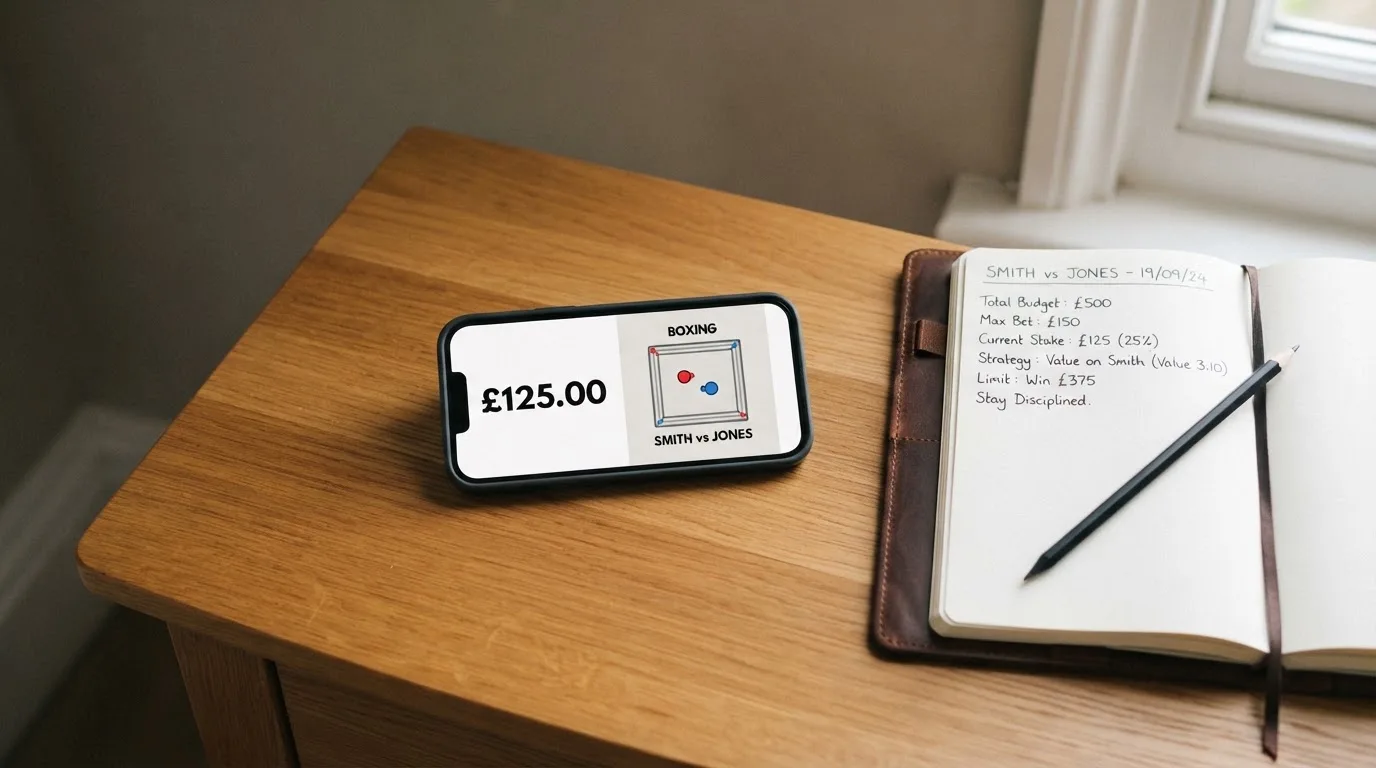
Bankroll management is the part of the strategy conversation that matters most and gets the least airtime. Staking a fixed percentage of bank on each selection, never chasing losses, accepting that any single bet can lose and the bank will survive, and tracking every bet to understand where the edge lives and where it does not — these are unglamorous mechanics that turn a betting hobby into a long-run exercise rather than a session by session ride. A punter who uses a tipster and stakes 5% of bank on every selection will outlast a punter who uses no tipster and stakes 20% of bank on the favourites. The first has the same expected value per bet, in the limit, but the volatility profile is much gentler.
There is no recipe for winning at boxing betting, and there is no system that beats the bookmaker’s margin across thousands of bets. The form study sharpens the price comparison; the bankroll management keeps the punter solvent while the form study is being learned. The two together are the strategy. Without the second, even a sharp model can be bankrupted by a bad week.
Markets, bet types and the language of a boxing slip
A boxing betting market is a slice of the fight’s possible outcomes priced at a given number. Markets run from the simple to the layered, and the simpler ones are the best place to start reading a slip.
The fight winner market prices each boxer and the draw as three separate outcomes. Two boxers and a possible draw is the shortest market in the book; the price the firm sets depends on the form of each fighter and on the level of recent opposition, with the favourite priced shorter and the underdog priced longer. The draw is usually the longest price on the market because boxing draws are statistically rare at high level: a draw occurs when the judges give both fighters equal scores, and the result is more common at lower cards than at world level. The Commission-regulated books price fights to take into account the operator’s view of how each boxer is likely to score, and the price incorporates the operator’s margin.
The method-of-victory market splits each boxer’s win into knockout or technical knockout, decision or disqualification. The detail matters because a knockout bet pays out only on a stoppage inside the scheduled distance; a decision bet pays out only on the judges’ scorecards; a disqualification is its own outcome, often priced separately. A bet on a boxer by method of victory is two bets in one: the punter has to be right about the winner and right about the method. The price is bigger than the simple winner price for that reason.
Round group betting, also called round band or round range, splits the fight into chunks of rounds — 1-3, 4-6, 7-9, 10-12 for a twelve-round fight, with the same mechanics for a ten-round or six-round contest. The market works best when a knockout or stoppage is expected; a unanimous-decision result means all round group bets lose. The price of each round group reflects the operator’s view of how the fight is likely to finish.
Total rounds over/under is the cousin of the round group market, with the punt priced against a line: total rounds over 8.5 means the fight has to go past the 1:00 mark of the ninth round for over bets to win, with under bets winning if the fight ends earlier. The line moves with the operator’s pricing of finishing power and of the expected pace of the fight, and a late injury or a long layoff can shift the line more sharply than the headline price suggests.
Go the distance is the yes/no market on whether the fight sees the judges’ scorecards. A “no” bet wins on a knockout, technical knockout or disqualification inside the distance; a “yes” bet wins on a decision. The price is a function of finishing power on both sides and of the operator’s expectation of the pace. A twelve-round fight between two durable, points-fighting boxers has a price that runs short on the “no” side and longer on the “yes” side; a fight between two punchers has the reverse.
To win in round X is the more granular version of round group, betting on the exact round the fight ends. Each round is priced on the operator’s view of finishing probability, with the round-by-round price adding up to less than the method-of-victory price in the operator’s fair model. Round-group betting pools round-by-round bets into bands and reduces the granularity in exchange for higher individual band prices.
The draw no bet market refunds stakes on a draw, leaving only the winner market to be priced. Two outcomes rather than three prices the markets more cleanly, and the price of each boxer is shorter than the equivalent fight winner price because the draw outcome has been removed. The market is popular with punters who want the cleanest win/lose read on the fight.
Betting exchange markets extend the same logic to back and lay, with the punter able to take either side of any of the markets above. The exchange is a venue where customers trade outcomes with each other; the operator takes a small commission on net winnings, not a margin baked into the price. The price is a function of supply and demand on the order book, with liquidity pooling on the major fights and thinning out on the smaller cards. A punted strategy on the exchange is to back a selection at one price and lay it off at another when the price moves, locking in a small profit on a market move rather than betting on the fight’s outcome.
Each-way betting, the staple of horse racing, carries across to boxing in a small way. The operator prices a place market alongside the win market: place terms vary by the fight and by the operator, often requiring a top-two finish or, on world title fights with heavy underdogs, a place at one-third the win odds. Each-way is two bets of equal stakes, so the total stake doubles. Boxing books tend to push each-way on title fights rather than on lower cards, where the place market may not be available.
Accumulator bets, or “accas”, bundle several selections into a single price. Each leg multiplies into the next, so a treble of three even-money shots is 8/1 rather than the single-bet price of 2/1. The compounded margin is the catch: each leg’s price carries the firm’s margin, and the accumulator multiplies the margins into a single number, so the overall margin on a multi-leg acca is meaningfully larger than the margin on each individual leg. Acca insurance refunds the stake on a near-miss — usually one leg losing — but refunds it as a free bet, with the same non-returning-stake trade-off as an ordinary free bet.
Bet builders extend the same idea within a single event. A punter picks two or more markets from the same fight — winner, method, round group, total rounds — and combines them into a single priced bet. The price is generated by the operator’s pricing model, with the firm charging more than the fair compounded price because pricing in-running multiple correlated markets is harder than pricing each one separately. Bet Builder+ on bet365 is the brand-name version of this mechanic, available pre-match and in-play, with a Winning Boost layered on top.
Cash out appears in this section as a market-of-one option on the bet itself. The bookmaker offers to buy the punter’s position at a stated price, with the price usually lower than the fair value at the moment of cash-out. The price is also withdrawable; cash-out can be unavailable on a given event for a stretch. The trade-off is identical to the in-play version: cash out is useful when the punter no longer believes the bet will win; expensive when used as a hedge on the original trade.
The overall list of markets on a major fight is long, and a smaller licensed bookmaker may carry only the winner, method of victory and round group markets on a low-tier card. The headline on a fight card is the fight winner; the detail is in the secondary markets; the spread is in how many of those secondary markets an operator carries and prices.
The professional boxing year
A professional boxing bout usually runs ten to twelve rounds, with a four-round fight common for newer fighters — a base the rest of the markets are built on. Each round lasts three minutes with a one-minute rest between rounds. Three minutes of work, one minute of recovery, twelve rounds of work for the longest bouts: the markets for round group and total rounds are scaled to those distances.
A bout can be won by knockout, technical knockout (a stoppage by the referee, doctor or corner), a decision on the judges’ scorecards, or disqualification for fouls. The taxonomy of finishes defines the method-of-victory markets on a boxing slip; each of those outcomes is priced separately in the main market, with disqualification typically more expensive than knockout on a single fighter. A punt on a boxer by method of victory is two bets in one — the winner and the method — and the prices reflect that.
The sanctioning bodies — the WBA, the WBC, the IBF and the WBO — title the world championships and structure the title picture. A boxer’s record is one thing; a boxer’s ranking across the four bodies is the part of the résumé that decides which fights are available. The belts sit at the top of the records; the major regional titles sit a rung below; the federation’s own rankings determine who is mandatory for whom. A bet on a title fight is a bet on a fight whose purse structure is governed by the body whose belt is on the line, and the sanctioning fees are typically split by the promoters and the boxers.
The professional calendar in Britain in 2026 carries a handful of major nights and a longer trail of smaller cards. The headline nights cluster around British and world title fights, with regional and area title fights on the supporting cards and club-card fights on the undercards. The major nights are the most-liquid events for betting, with the deepest markets and the longest price lists; the lower-tier cards are where a smaller licensed bookmaker with a sharper boxing product can out-do a bigger bookmaker with a sparse product.
Olympic boxing and amateur boxing, in contrast, are a different product. The AOB rules, the headgear rules, the ten-point must scoring, and the round structure are different, and the same operator typically prices amateur bouts with a smaller market depth. Olympic boxing betting odds are often restricted to winner markets during the Games, with the betting volume concentrated on the medal rounds and limited to a few weeks of activity.
Exchanges do better on the larger fights than on the smaller ones, and back-to-back weeks of small cards thin out the order book at every venue. The punter who reads the calendar and concentrates staking on the title fights can usually get a tighter spread, a deeper book and a sharper product on those nights than on a routine club-card weekend. On a routine weekend, the fixed-odds bookmaker’s product is usually the better venue — the markets are fewer but firmer, and the firm’s research desk has usually done the form work.
How the price is built, and what the margin actually takes
The book’s margin is the slice of every pound staked that the firm keeps, on average, across a large number of outcomes. The margin is baked into the price rather than charged separately, and the closer the sum of implied probabilities across a market is to 100%, the smaller the margin. A two-way fight winner market priced at 1.91 / 1.91 implies a probability of 52.4% on each side, summing to 104.8% and a margin of 4.8%. The difference between the sum of implied probabilities and 100% is the margin, and the bigger the difference, the more the firm keeps.
An illustrative example helps. Take a fight priced at 1.90 / 1.90 — even money, both sides equally priced. Convert the decimals to implied probabilities by dividing one by the odds: 1 / 1.90 = 52.63% on each side. The two probabilities sum to 105.26%, so the overround is 5.26%, and the margin on this illustrative market is between roughly 5.0% and 5.3%, depending on rounding. The firm’s edge is built into that gap: on every £100 staked on this market at the published prices, the firm expects to keep around £5 of profit on average, before operating costs and the take from any unbalanced book.
A three-way market, with each side priced at 2.50 and the draw at 13.00, works differently. Each side implies a probability of 1 / 2.50 = 40.00%, and the draw implies 1 / 13.00 = 7.69%. The sum is 40.00% × 2 + 7.69% = 87.69%, which is less than 100%, indicating a margin of 12.31%. A three-way market with a long draw price and tight favourite prices can carry a much larger margin than a two-way market, because the firm has to price all three outcomes explicitly. The price of the draw, even when long, is enough to push the sum of probabilities a few points past 100% in most markets.
The implications run two ways. A punter looking for value should look at the market with the smallest margin first, because that is the market where the firm’s edge is smallest and the punter’s edge, if there is one, has the most room to live. Within a single card, that usually means the method-of-victory and round-group markets are cheaper for the punter than the long-odds “any other” markets, because the firm has priced the rare outcomes more generously. Across operators, the same market on the same fight can carry different margins on different books; a 2% margin difference on a £100 stake is £2 in expected value across many bets, and that compounds.
The market margin is also visible in the secondary markets of a bout. An each-way bet effectively halves the stake and doubles the selections, with both halves priced to reflect the firm’s view. A bet builder bundles multiple markets from one event into a single price, with the price usually carrying more margin than each constituent market would have priced separately. The compounding mechanics operate the same way: more legs, more margin baked in.
The arithmetic that gets a punter to expected return is straightforward but worth restating. A winning single bet of £10 at decimal odds of 4.50 returns £45 — the stake of £10 plus the profit of £35 — for a net profit of £35 on the £10 stake. The return on the stake is 4.5x. A winning combination bet of £10 across two selections at 3.00 and 4.50 returns £10 × 3.00 × 4.50 = £135 — the stake of £10 plus the profit of £125 — for a net profit of £125 on the £10 stake. The compounded price is 13.50, the operator’s price on the combined selection, and that compounded price has compounded the margin of each leg into the final price.
That compounded price is the place the firm’s edge earns the most on a multi-leg accumulator. Three legs at 2.00 each compound into a compounded price of 8.00. The fair price, with each leg at a 5% margin, would be closer to 7.20 — a difference of around 11% on the compounded price, all margin. A punter who regularly backs short-priced favourites in accas is paying a hefty margin over the compounded fair price, and a sharp acca strategy is to back longer-priced selections where each leg’s margin is a smaller percentage of the compounded price.
The margin is not a fee. Nothing is deducted from the stake; the slip is settled at the printed price and the firm’s edge is paid by the difference between the printed price and the firm’s view. Reading the margin in real time is the skill the market quietly demands of every punter, and the skill that distinguishes the long-run player from the session-by-session punter.
The ten licensed bookmakers this page ranks
The list that follows is a review of ten Gambling Commission-licensed bookmakers that carry boxing products on their UK-facing sites. Each card names what sets the operator apart within the comparison; the bare brand name on every card would tell the reader nothing. The reviews are based on each operator’s own published terms, on the Commission’s public register, and on the apps’ own descriptions in the public app stores.
BoyleSports — Irish-rooted bookmaker with a sharp UK boxing card
BoyleSports’ sports welcome offer runs £20 in free bets when a £10 bet is placed, with a euro-denominated mirror for Irish customers. The remote betting licence is held by Boylesports Enterprise under Gambling Commission account 39469. BoyleSports has built a particular depth on British and Irish boxing, with cards priced across winner, method of victory and round group markets on most nights and tighter in-play coverage than several larger competitors. The licensing and welcome-offer structure make it a sensible opener for a punter new to boxing betting and a useful secondary book for a punter who already has a primary account elsewhere.
Hollywoodbets — South African-rooted bookmaker with acca-led promotions
Hollywoodbets’ sports welcome offer refunds the stake as a free bet of up to £30 on the first qualifying losing accumulator, on deposits of £10 or more by card, with the qualifying acca carrying three or more legs at odds of 4/1 or greater, settled within seven days, with one free bet per customer. The remote betting licence is held by Hollywoodbets International UK Limited under Gambling Commission account 53028. The product is acca-led rather than singles-led, with the welcome offer designed for punters who build accas across sports. A punter who bets mostly singles will find the offer’s qualifying criterion narrow; a punter who bets accas across football, boxing and the wider card will find it well-aligned with the firm’s product.
Bet600 — spread-meets-fixed-odds product with best odds guaranteed on racing
Bet600 pays Best Odds Guaranteed on horse racing — the starting price, if larger than the early or show price taken, is the price the bet is paid at. The remote betting licence is held by Tyche Tech Limited under Gambling Commission account 44731. The product is a fixed-odds sportsbook with a racing-led product on top, and the horse-racing BOG is one of the more generous offer types in the British market. A punter whose betting is mostly boxing and football will read the BOG as a useful side feature rather than a primary draw. A punter whose betting mixes horse racing with boxing will read the BOG as the primary reason to be at the firm.
Tote — pool-betting-led product with a smaller published welcome offer
Tote’s remote betting licence is held by TDCO Limited under Gambling Commission account 54779, covering remote general betting standard for real events. The product is pool-betting-led with a fixed-odds layer on top; the firm’s heritage is in horse racing and greyhound pools, and the boxing product is a smaller slice of the overall book. A punter whose betting is mostly boxing will likely want a fixed-odds-led book alongside; a punter who mixes horse racing and boxing will find the product useful for both because of how the racing pools and the boxing lines sit inside the same account.
Unibet — long-established European bookmaker with a steady welcome package
Unibet has operated since 1999 at company level, and its UK site is run by Platinum Gaming Limited, Gibraltar, under Gambling Commission account 45322. The sports welcome offer credits £40 in free bets when the punter deposits and bets £20 at minimum odds of 2.0 (1/1), with the free bets expiring within seven days of issue and the offer restricted to new GB customers using a debit card or instant bank transfer. The product depth on boxing is solid across winner, method of victory and round group markets, with a decent in-play product and a long-standing mobile app. Unibet is the safer pick of the comparison for a punter who wants an established European firm with a stable welcome package and a multi-sport footprint.
Coral — sister brand to Ladbrokes under LC International, with a similar welcome shape
Coral’s sports welcome offer mirrors Unibet’s on the headline number — £40 in free bets when the punter deposits and bets £20 at minimum odds of 2.0 (1/1), with the free bets issued within seven days and expiring seven days after issue, restricted to new GB customers who opt in. The remote betting licence is held by LC International Limited, the same licensee that holds Ladbrokes’ UK licence, under Gambling Commission account 54743; the categories on the register include remote general betting standard for real events and remote betting intermediary, the latter because Coral runs a betting exchange alongside its fixed-odds product. A punter new to the firm will find the welcome structure familiar if they’ve read Unibet’s terms, and the betting intermediary licence is a useful feature for customers who want to back and lay within one account.
DragonBet — Welsh-rooted bookmaker with a deep in-play and bet builder product
DragonBet’s app is published by DragonBet Ltd, with the firm’s licence held under Gambling Commission account 64908. The app covers Welsh football and rugby, racing, American football, in-play betting and bet builder markets. The product is regional and rugby-led on top of a multi-sport base, with boxing carried across the in-play and bet builder layers in the same way football and racing are. A Welsh punter looking for a regional book with national sports coverage will find DragonBet well-aligned; a London-based punter with no Welsh-rooted betting habits will find the regional angle more of a curiosity than a draw. The mobile product is the firm’s main surface; the desktop product runs as a smaller secondary channel.
DAZN Bet — DAZN-branded bookmaker with low deposit minimums and a betting exchange coterie
DAZN Bet’s deposits start at £5 by debit card, Apple Pay, Paysafecard, Trustly and Skrill, and at £20 by PayPal, with no processing fees. The remote betting licence is held by DZBT Limited under Gambling Commission account 48756. The product is fixed-odds sports betting carrying the DAZN brand, with a multi-sport book and a particular depth on football, American sports and boxing. The £5 minimum is one of the lowest at the licensed firms and is useful for punters running a small bankroll. The product sits inside the DAZN broadcast relationship rather than alongside it, so the live-streaming rights that DAZN the broadcaster holds do not flow through to the betting product.
Matchbook — betting exchange with horse racing and greyhound streaming on top
Matchbook is a betting exchange, not a fixed-odds bookmaker — customers bet against each other rather than against the firm, with the operator taking a small commission on net winnings. The remote betting licence is held by Triplebet Limited under Gambling Commission account 39504, with categories covering remote general betting standard for real events and remote betting intermediary. The product carries a Bet Builder, multiples, in-play betting and live streaming of horse racing and greyhounds; the boxing product runs through the order book on the major fights with thinner liquidity on the lower cards. The exchange model means the price on a fight is a function of supply and demand rather than of the firm’s view, and a sharp exchange user will out-trade the bookmaker on the heavy nights.
Betfred — long-established British bookmaker with a multi-app single-firm footprint
Betfred’s app is published by Done Brothers (Cash Betting) Ltd, with the firm’s remote betting licence held by Petfre (Gibraltar) Limited under Gambling Commission account 39544. The app covers twenty-one sports plus over two thousand casino-style games, with the gaming side operating under a separate casino licence alongside the betting licence. The product has been around the longest of the ten firms on the page, with a high-street heritage rooted in the UK betting shop trade. The mobile product combines a sportsbook, a casino and a games lobby in a single app. A punter looking for the high-street firm with the deepest multi-app offering will land at Betfred; a punter looking for the most modern mobile-only product will look elsewhere.
How the brands compare on licensing and welcome terms
The table below summarises the licence and the welcome-offer headline for each of the ten bookmakers on the page. The Gambling Commission’s account number is the single fact the table carries that a punter can independently verify, by searching the Commission’s public register. The welcome-offer headline uses each operator’s own published phrasing rather than a standardised gloss, so a punter can match the table line to the marketing the firm actually does.
| Brand | Gambling Commission remote licence | Licence holder | Welcome offer headline |
|---|---|---|---|
| BoyleSports | 039469-R-319383-025 (39469) | Boylesports Enterprise | £20 in free bets on a £10 bet |
| Hollywoodbets | 053028-R-330019-013 (53028) | Hollywoodbets International UK Limited | Stake returned as a free bet up to £30 on first losing acca |
| Bet600 | 044731-R-323941-016 (44731) | Tyche Tech Limited | Best Odds Guaranteed on horse racing |
| Tote | 054779-R-331321-008 (54779) | TDCO Limited | No headline welcome offer published |
| Unibet | 045322-R-324275-019 (45322) | Platinum Gaming Limited | £40 in free bets on a £20 qualifying bet |
| Coral | 054743-R-330863-014 (54743) | LC International Limited | £40 in free bets on a £20 qualifying bet |
| DragonBet | 064908-R-339041-003 (64908) | DragonBet Ltd | No headline welcome offer published |
| DAZN Bet | 048756-R-327274-019 (48756) | DZBT Limited | Deposit minimum £5 across most methods |
| Matchbook | 039504-R-319407-024 (39504) | Triplebet Limited | Commission-based exchange pricing |
| Betfred | 039544-R-319290-010 (39544) | Petfre (Gibraltar) Limited | Multi-app sports and casino product |
The headline offer on Tote and DragonBet was not published on the home pages reviewed; the table therefore leaves those rows blank rather than guessing. A punter deciding between BoyleSports and the £40 welcome at Unibet or Coral is looking at slightly different products: BoyleSports’ £20-on-£10 trigger is lower-threshold, while the £40-on-£20 trigger at the other two firms pays out more in absolute terms if the qualifying bet wins. Each carries its own minimum odds and expiry window; the table cannot capture those without crowding the columns, and the terms are best read at the operator’s own page before the qualifying bet is placed.
Reading this market as a single picture
A beginner’s read of a boxing betting market is the headline price — the favourite at 4/6, the underdog at 11/4, the draw at 8/1. Each of those is a number the punter can place a stake on, with the same kind of slip regardless of whether the bet is a winner bet, a method-of-victory bet or a round-group bet. The middle of the market — the day’s method-of-victory prices, the round-group bands, the go-the-distance line — is where the depth of the product lives and where the firm’s pricing work shows. The longer a punter reads the market, the more pages of the slip will start to look like a working document rather than a poster.
A sharper read takes the same numbers and asks where the edge is. That means comparing the same market across two or three operators, looking at the margin the firms are running on the same fight, and choosing the book with the smallest margin when no other difference is decisive. It means reading the method-of-victory market on the same card and noticing which operator carries which submarkets. It means treating the live in-play prices as a separate market with its own liquidity profile rather than a refresh of the pre-match price.
A professional’s read takes all of that and adds the discipline of a staking plan, a written record of every bet, and a willingness to sit out the fights where the edge isn’t clear. That last item is the hardest: the punter who bets every fight is a punter whose long-run return is bounded by the firm’s margin minus the punter’s edge, and the punter who bets only the fights where the edge is real has a wider margin of error on every bet but a tighter bankroll requirement overall.
None of that should be read as a route to guaranteed profit. The book’s margin is built into every price, and a punter who beats it on one fight will lose to it on the next. The arithmetic above is what the page promises: a way to read the price, a sense of what the market does, and a list of ten licensed firms where the price can be read at all. That is the offer of the page, and the rest is the punter’s own.
Frequently asked questions
How can I bet on boxing in the UK?
Boxing betting requires an account with a Gambling Commission-licensed operator. Once verified, you can select a fight, choose your market, enter your stake, and confirm on the slip. Settlements are based on the fight’s result, and free bets are available through promotional terms.
How does online boxing betting work?
Online betting involves selecting a market on a bookmaker’s app or website. You search for the event, choose the price, enter your stake, and place the bet. New customers must complete registration and identity verification before depositing or placing any bets.
How do I check if a boxing bookmaker is licensed?
You can check a bookmaker’s licence by searching the Gambling Commission’s public register using their trading name, domain, or account number. A legitimate operator will appear in the register, showing their current operating licence and any active conditions. If no record is found, the site is unregulated.
How is the return on a boxing bet calculated?
The return on a winning bet is the stake multiplied by the decimal odds. Net profit is the stake multiplied by the decimal odds minus one. Combination bets compound the prices of each leg, so a £10 double at 3.00 and 4.50 returns £135 in total.
What does the bookmaker’s margin mean?
The margin is the percentage of stakes the bookmaker retains on average across many bets. It is built into the odds, appearing as the difference between the sum of implied probabilities and 100%. A smaller margin indicates more competitive pricing for the punter on that specific market.
Combat & motorsport – Motorracingtips.com
Content created by the «Motorracingtips.com» team
