
Ante post betting 2026: the price, the rules, the bookmakers
 Available in US
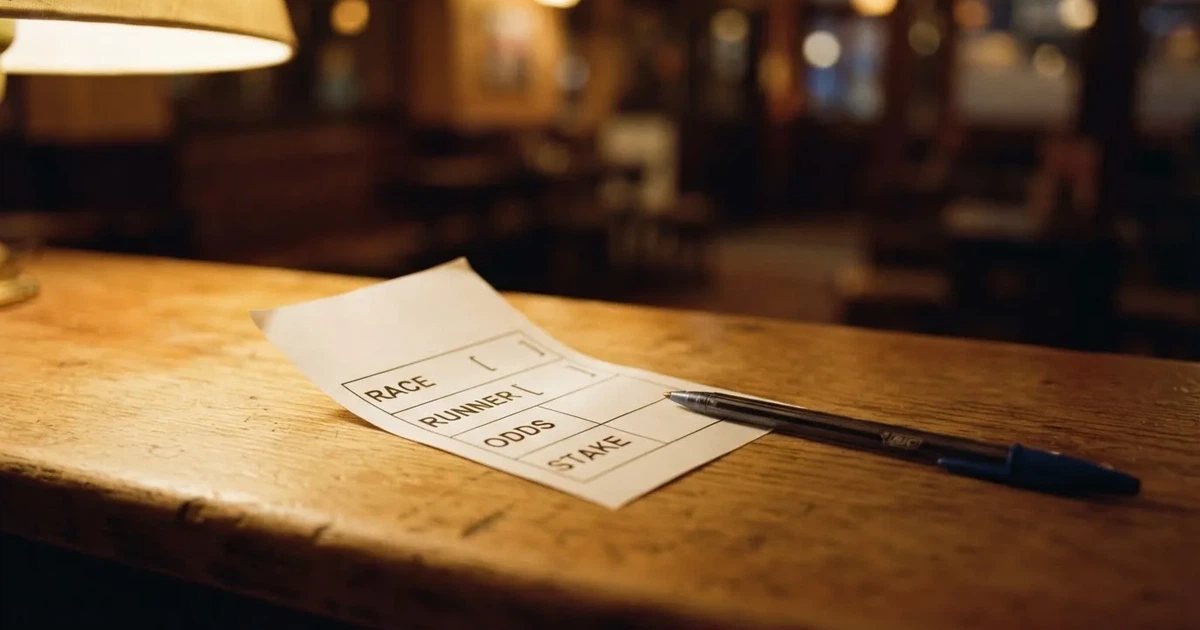
A blank paper betting slip sits on a wooden counter beside a pen, the kind you’d fill in for the Grand National three weeks before the tapes go up. That image is what ante post has always been: a wager struck well before the runners parade, with the odds that morning, on a horse that may not line up at all. The market is older than the smartphone and the rules have not kept pace with the marketing. This page is a costing of it, written for a British punter who wants to know what an ante-post bet really pays, what voids it, and which of the ten bookmakers named below deserve a stake.
Data current as of October 30, 2026 and cross-checked against the Gambling Commission’s public register of remote operating licences.
Playing it safe before the first bet is struck
A future-racing bet is unusual because the punishment for being wrong is the same as the punishment for picking the wrong horse. Strike an each-way ante-post wager on a 12/1 outsider that pulls out on the morning of the race, and the stake is gone — there is no refund, no void, no second chance. That is the rule the marketing material never puts first. It is also the rule that makes the rest of the page worth writing: nothing else about ante-post wagering is as expensive as the part the bookmakers leave out.

GAMSTOP is the first thing a GB punter should know about, because it is the lever that pulls every other one. From 31 March 2020 any operator holding a remote operating licence from the Gambling Commission must check new customers against the central self-exclusion register and block anyone on it. Exclusion can be set for six months, one year, five years or five years with auto-renewal, and once the chosen period ends it stays in force for a further seven years unless the punter asks GAMSTOP to lift it. A GAMSTOP-registered gambler cannot simply open another account with a sister brand under the same corporate roof — Ladbrokes and Coral both sit on Ladbrokes Betting & Gaming Ltd’s licence, so they share the check. The ten bookmakers reviewed below are all on that register, because holding a GB remote licence is what GAMSTOP membership requires.
Beyond GAMSTOP, the Commission’s licence conditions and codes of practice put three further rails around an account. Name, address and date of birth are checked before the first deposit or bonus — verification has been mandatory since 7 May 2019, and a free bet counts. Once the rolling 30-day net spend (deposits minus withdrawals) crosses £150, a light-touch financial vulnerability check runs: a public-record search for county court judgments or bankruptcy, not a credit reference, not a payslip request. Operators must offer a deposit limit on a fixed time frame; the first phase of the new deposit-limit regime has applied since 31 October 2025, a second was postponed to 30 September 2026, and whether it is live is not established. The deeper “affordability check” the press calls a financial risk assessment was announced in stages on 7 July 2026 with no start date. Credit cards have been banned for gambling in Great Britain since 14 April 2020, including credit-card-funded payments through an e-wallet, which is why a Visa debit card or a bank transfer remains the working route in.
Help exists and is worth naming. GamCare runs the National Gambling Helpline, GambleAware funds treatment and research, the NHS runs clinics in several regions and Gamblers Anonymous runs meetings. None of these will lift a Rule 4 deduction or a void ticket after the event. Their job is to keep the punter in one piece; the rest of this page is about keeping the punter’s stake in one piece. When the markets close and the bet loses, the only line of defence is the rule book the punter read before clicking.
What the tipsters charge for the tip
A punter who reads a “tip” before placing a future-racing bet is paying for the tipster’s reputation, not for certainty. The tip itself is unforecastable. The form is the form. What a tipster can sell is selection discipline — the practice of writing down prices, tracking results, refusing to back anything shorter than the value line — and that is the same work a punter does for free with a notebook. The “strategy” column in the racing press is mostly the same content reformatted, and the same caveats in thirty that end with “please gamble responsibly” carry the same price.

The real cost in this corner of the market is the rule called Rule 4. When a runner is withdrawn from a race after the betting has been formed, the bookmaker reduces the payout on every winning selection according to a published table: a non-runner at odds of 5/2 or shorter takes 10p in the pound from the winnings, an odds-on withdrawal takes 75p in the pound. Ante-post bets feel the rule on race-day non-runners; the day’s betting board is the one that triggers it. The deduction is taken from profit, not from the stake, so a winning £10 each-way bet at 10/1 minus a 15p Rule 4 still returns something — just less than the punter thought.
Then comes the second, less obvious rule: an ante-post stake on a horse that does not run loses. That is the difference between an ante-post wager and a day-of-race wager, and it is the rule that distinguishes this corner of the market from every other. A punt the day before the race on a horse that is declared a non-runner at declaration time usually voids with the stake returned. Strike the same selection ante-post the week before and the stake goes with the horse. The price you saw on Monday is the price you lose on Friday.
The arithmetic that follows is the only honest strategy in this market. The bookmaker’s margin, applied to the price the punter takes, gives the long-run cost of every pound the punter bets. There is no model that picks winners, and no service that sells one. There is the price the punter accepted, the market that priced it, and the difference between them. Strategy is taking the larger of the two.
Bets, prices, and what the market pays out
A “bet” at a British bookmaker is a wager against the house on the outcome of a real event — a horse race, a football match, a tennis final. The “price” or “odds” is the multiplier that turns the stake into a return. At fractional odds of 5/1, a £1 stake returns £6 (£5 profit plus the £1 stake back); at decimal odds of 6.00, the same stake returns £6 in one step. Decimal odds dominate the apps and the bet builders now, but fractional odds remain the native form on a British racecard. Conversion is mechanical: a/b becomes a÷b + 1, so 5/1 is 6.00 and 11/4 is 3.75.
A “single” is one selection, one outcome. A “double” combines two selections; both must win. A “treble” is three. An “accumulator” or “acca” stacks four or more into one ticket, and the odds multiply leg into leg, so four legs at 3.00 each become 81.00 — a £1 stake returns £81. The bookmaker’s margin sits inside every one of those prices, and on a long-priced accumulator the margin compounds, which is why a punter picking four short favourites and a punter picking one 50/1 outsider both pay roughly the same percentage to the house.
An each-way bet is two equal bets on one slip: one on the horse to win, one on the horse to place. The stake doubles. The place terms depend on the race — a four-runner race pays a quarter of the win odds for the first two places, an eight-runner handicap pays a fifth for the first three, a twelve-runner non-handicap pays a quarter for the first three. The place terms are set by the operator and printed beside the race. Ante-post place terms are the same.
A non-runner rule is what ante-post changes. The default at a GB bookmaker, for a bet on the day of the race, is that a non-runner makes the bet void with the stake returned. Ante-post inverts that rule: a non-runner loses the bet, and the stake is gone. A punter who treats the future markets and the day-of markets as the same product is paying for the lesson twice.
Ante-post betting is not restricted to horse racing. Football outrights — league winners, top scorer, relegation — are ante-post from the moment they are priced, often months before a ball is kicked. Tennis outright markets are ante-post from the draw publication. The same non-runner logic applies with a different label: a footballer who transfers mid-window, a tennis player who pulls out injured, can void the bet or run it on, depending on the operator’s terms and on whether the bet was a single or part of an accumulator. The rule is the bookmaker’s, not the sport’s, and it is the punter’s job to read it.
A “Rule 4 deduction” is the day’s deduction, not an ante-post one; it bites on bets struck on the day, when a horse is withdrawn after the market has formed. The deduction is published in pence in the pound and is taken from profit. An ante-post wager does not run on the day’s board and does not see a Rule 4 deduction — but the horse still loses if it does not line up, and the punter’s stake still walks.
How a future-racing bet actually settles
Strike a £5 ante-post bet on a 10/1 shot for the Cheltenham Gold Cup. The slip is recorded at the price the morning you placed it. From that point until the race the horse can shorten or drift on the betting exchange, can be pulled out by the yard, can pick up an injury in a schooled gallop, can be balloted out at final declaration stage. None of those events changes the price on the slip. The bet runs at 10/1 until the result is known.
If the horse runs and wins, the bet pays £55 (£50 profit plus the £5 stake). If the horse runs and loses, the bet pays nothing. If the horse does not run at all, the bet pays nothing — there is no refund on a single ante-post wager. If the race is abandoned, the bet voids and the stake returns. If the race is moved to a different track, the bet voids and the stake returns. Those four outcomes are the rule book for a single.
An ante-post accumulator behaves differently on a void leg. If one of the four legs is balloted out or scratched before declaration, the accumulator runs as a treble at the original three prices. A punter who struck a four-leg ante-post acca at combined odds of 81.00 and loses one leg to a non-runner sees the bet settle on the other three at their original prices — which is rarely the same price as the original acca’s combined odds, because the odds that won their place on the slip were the morning’s, not the day’s. The accumulator’s original 81.00 is gone with the missing leg; the treble’s 27.00 is what settles.
Place-only, conditional and forecast bets are not accepted on ante-post markets. A forecast is a wager on first and second in the right order; a tricast is first, second and third. Both are settled on the day’s SP and cannot be struck ahead of declaration. A conditional is “if this horse runs, back it for the place” — meaningless on an ante-post slip, because the book is the bet.
The rule that punter and bookmaker cannot rewrite is the rule on price being *taken*. Every ante-post bet settles at the price available when it was placed, not at the day’s starting price, not at the morning’s revised price. A punter who struck at 10/1 in November gets 10/1 regardless of whether the horse wins in March at a morning price of 4/1 or drifts to 20/1 by declaration, paying the same £55 in either case. The price is the price the punter accepted.
Two further mechanics belong in the same paragraph. Best Odds Guaranteed (BOG) is a concession on day-of bets: if the starting price is bigger than the price the punter took, the book pays the bigger. William Hill’s BOG applies from 8 AM on the day of the race on UK and Irish horse racing, on both single and multiple bets, and explicitly does not apply to ante-post, tote or pari-mutuel bets. Cash out is a separate concession: a bookmaker offers to buy the bet back mid-event or mid-race, and the punter can take the offered price or let the bet run. Cash out is rarely offered on ante-post markets in the same form, because the market is illiquid and the offer is hard to price. Where a bookmaker offers it, the offered price is the bookmaker’s, and the punter is selling a winning ticket at a discount for the certainty of a return today.
Ten UK bookmakers that take ante-post bets
The ten operators below each hold a Gambling Commission remote operating licence for general betting on real events. They are listed because they hold a licence, not because they are ranked. Several of them are stronger on horse racing than on football outrights, and several are stronger on price than on ante-post depth. Where a brand’s offer cuts against the subject of ante-post wagering, the page says so: a brand with thin future-racing markets and a brand that does not settle non-runners the way the rule says are both named, because a comparison that hides the cut-off is not a comparison.
| Brand | Gambling Commission remote licence and licence holder | What the operator’s own terms state on ante-post |
|---|---|---|
| Fitzdares | Account 400 (Fitzdares Limited) | App offers ante-post markets on horse racing, football, tennis, rugby, cricket, golf and American football alongside cash out, accumulators, Lucky 15s, specials and in-play live odds |
| Tote | Account 54779 (TDCO Limited) | Best Odds Guaranteed from 8 AM on UK and Irish racing applies to single and multiple bets and does not apply to ante-post, tote or pari-mutuel bets |
| Geoff Banks | Account 54095 (GB Sports Advisors Limited) | App publishes live in-play prices and ante-post prices on future events |
| Lottoland | Account 38991 (EU Lotto Limited) | App combines casino, lottery betting, sports betting and scratchcards and states it is licensed by the Gambling Commission for customers in Great Britain |
| Betmaster | Account 65699 (BM Solutions GB Ltd, Malta) | Site states it holds Gambling Commission account number 65699 |
| 10bet | Account 43173 (Blue Star Planet Limited) | Sportsbook covers football, tennis and horse racing with cash out, bet builder and live streaming |
| bet365 | Account 55148 (Hillside (UK Sports) ENC) | App offers Bet Builder+ combining markets from one event into a single bet pre-match and in-play, Super Boosts, Winnings Boosts on Bet Builders and selected singles, and daily Bet Boosts |
| Copybet | Account 53774 (Copybet UK Limited) | App offers Best Odds Guaranteed all day every day on all UK and Irish racing and pays first past the post on horse racing even if the winner is later disqualified |
| London Bet | Account 66162 (Thistle Bet Limited) | App states it is licensed and regulated in the UK with a 17+ age rating |
| BetMGM | Account 39198 (LeoVegas Gaming PLC) | Sports welcome offer for new UK customers who deposit £10 or more and place a sports bet within 7 days is four £10 free bets, valid for 7 days with minimum odds and opt-in required |
The picture the table paints is uneven. Tote and Copybet pay first past the post and offer some form of price guarantee, but the guarantee explicitly excludes ante-post, so the concession is moot for the market this page covers. Fitzdares and Geoff Banks lean into the future markets explicitly. 10bet, bet365 and Copybet carry the bet builder and cash-out features a multi-leg punter will use, but the bet builder is a same-event tool and rarely applies to an outright. Lottoland is the outlier in the set — its licence is real, but its sportsbook is secondary to lottery betting, and the ante-post depth is not its selling point. BetMGM’s welcome structure is the kind of offer the punter must read carefully: the four £10 free bets are split into two football accas of 4+ selections and two sports multiples of 2+ selections, valid for 7 days, and the minimum-odds threshold is what determines whether the bonus clears or expires — a question of staking pattern rather than sporting judgement.
What the table leaves out
The licence number is the minimum test the punter can apply from a kitchen table. The Commission’s public register lists every GB remote operating licence, and the search accepts a business name, a trading name, a domain or an account number. A punter who cannot find the brand on the register should not deposit. The bonus cap is the next test: from 19 January 2026 any wagering requirement on a bonus is capped at 10x, which means a £10 bonus at 50x no longer exists — the cap is £100 of required turnover at 10x. The £150 rolling-30-day vulnerability check is the third: an account that has not crossed it is in the cheapest tier of regulation, and the punter has seen nothing yet of the affordability regime that has been announced in stages.
The shape of the market before any horse runs
An empty football stadium at dusk, with the floodlight masts not yet lit, is the picture of ante-post betting in its purest form. The bet has been placed. The event has not. The price is the price the punter accepted. Nothing else is going to change.
This is the cornerstone of the ante-post market and the thing the marketing never quite says. A future bet locks in three things at the moment of placement: the selection, the price and the rule book. The selection can scratch. The price can move against the punter elsewhere, but not on the slip. The rule book stays put. The punter pays for the certainty of those three locks with the cost of a non-runner — the stake is the punter’s, and the horse is the horse’s, and the race is the course’s, and none of them belong to the bookmaker once the bet is on.
The shape of the market is also shaped by the betting exchange. On a betting exchange, a punter can back a horse at one price and lay the same horse at another, and the market that forms is a market of punters pricing each other. The bookmaker’s margin sits on one side of that market and the exchange’s commission sits on the other. A punter who watches the exchange sees the true market price drift through the day, while the bookmaker’s ante-post price lags or leads according to the bookmaker’s liability book. The exchange is not a substitute for a bookmaker — the bookmaker pays first past the post in some cases, the exchange settles only on the official result — but the exchange price is a fair read of where the horse should be, and a punter who reads both gets a sharper picture than either alone.
In horse racing, ante-post season runs from the moment the book opens. The Cheltenham Festival ante-post book opens in earnest around late autumn; the Grand National book opens earlier still and runs through the spring. Football outright markets for the following season open in the summer and run to the final whistle. Tennis outrights run from draw publication through to the final. The longer the book has been open, the larger the overround tends to be — bookmakers price for uncertainty on the day, and the longer the bet sits, the more uncertainty the punter is paying the bookmaker to hold.
The figure the punter pays for that uncertainty is the margin, and the margin is the only honest number on a price board. A 5/1 shot does not mean a one-in-six chance. A 5/1 shot at a 20% margin book means something closer to a one-in-seven chance, and a 5/1 shot at a 35% margin book means closer to one in eight. The difference between those two chances is the punter’s expected loss per pound bet, and the only way to see it is to convert the prices to implied probabilities and add them up.
What the margin looks like in the odds
Take an illustrative two-way market priced at 1.90 / 1.90 in decimal odds (9/10 each side in fractional form). The implied probability of each outcome, before margin, is 1 ÷ 1.90, which is roughly 52.6%. Add the two implied probabilities and the sum is roughly 105.3%. The bookmaker’s margin is what is left over after a 100% fair book — in this case the band sits at roughly 5% to 5.5% of total stake, the standard margin a sharp bookmaker runs on a close two-way market such as a tennis match or a baseball moneyline.
The same arithmetic on a three-way football match at 2.50 / 3.40 / 2.90 produces a sum of implied probabilities well above 106%, often closer to 108% on a top-flight fixture. The punter pays the difference between the implied probability and the fair probability on every pound bet, and over the long run the punter’s losses equal the margin on the market. A 5% margin costs 5p per pound over thousands of bets; an 8% margin costs 8p. That is the price of the bookmaker’s service, and the only way to pay less of it is to find the same selection at a sharper price elsewhere.
What the law actually permits in Great Britain
An empty courtroom in morning light, with wooden benches catching the sun, is the right backdrop for the rule book on which ante-post wagering sits. The Gambling Act 2005 covers Great Britain — England, Scotland and Wales — and leaves Northern Ireland outside, where the older regime applies. Since the Gambling (Licensing and Advertising) Act 2014 an operator whose remote facilities are used in Great Britain needs a Gambling Commission licence wherever it is based, and a Curaçao, Maltese or Gibraltar licence is not a substitute at the point of consumption. The Commission’s public register is the whole test of who holds one, and it can be searched by name, trading name, domain or account number.
What may be bet on is not enumerated by statute. There is no list of permitted markets and no list of prohibited ones. An operator holds a licence for a category — remote general betting standard (real events), remote general betting standard (virtual events), remote pool betting, remote betting exchange — and offers markets under its own house rules and the Commission’s Licence Conditions and Codes of Practice. In-play betting is offered by GB bookmakers under those same rules; nothing in the statute makes in-play either permitted or banned as a category. Esports, virtual events, politics, TV and novelty markets all sit on the same footing: permitted unless an operator decides otherwise.
Tax and bonus rules are the two other levers the punter will feel. The player pays no tax on betting winnings in Great Britain — general information, not advice, and a professional gambler should ask HMRC or an adviser. General Betting Duty is the operator’s tax on gross profits at 15%, and from 1 April 2027 a new remote betting rate of 25% applies within it, while remote bets on UK horse racing, bets on self-service betting terminals in licensed premises, pool betting and in-person betting stay at 15%; the rates do not change before then, and whether operators pass the duty on through odds is not established. The wagering-requirement cap of 10x on bonuses is in force from 19 January 2026, mixed-product promotions — an offer that requires gambling on two or more product types, such as “bet on football to get free spins” — are banned, and neither the cap nor the ban alters the ante-post rule book, which is the operator’s.
Enforcement is at the operator. Providing gambling facilities in Great Britain without the licence the Act requires is an offence under section 33 of the Gambling Act 2005, on summary conviction up to 51 weeks’ imprisonment, a fine up to level 5, or both (six months in Scotland). No offence is aimed at the customer who merely bets on an unlicensed site: the practical loss is the loss of the British consumer protections — no GAMSTOP coverage, no Commission complaints route, no approved dispute-resolution body, no recourse if funds are withheld, and no obligation on the operator to honour the 10x bonus cap or the £150 vulnerability check. The honest framing is the one the punter can hold in one hand: licensed means checks, limits, GAMSTOP and the bonus cap, but also identity verification before the first deposit; unlicensed means none of those protections and the possibility of a stalled withdrawal. Neither is “the safe choice” by default.
Operator reviews: each bookmaker’s ante-post proposition
Each block below names what the licence line, the offer and the ante-post proposition look like at the operator named, and ends on the page’s own judgement of what the brand does and where it falls short.
Fitzdares
Fitzdares holds Gambling Commission account 400 under Fitzdares Limited, and the licence category on the register is remote general betting standard (real events). The Fitzdares product explicitly leans into the future-racing market. The app offers ante-post markets on horse racing, football, tennis, rugby, cricket, golf and American football, alongside cash out, accumulators, Lucky 15s and specials, with in-play live odds running as well. The depth across seven sports is the strongest ante-post proposition in the reviewed set, and the punters most likely to use it are the ones who want outright exposure across more than one sport in one wallet.
Where Fitzdares falls short is on concessions. There is no Best Odds Guaranteed concession named in the public materials reviewed, and the ante-post book settles at the price taken at placement. A punter who strikes a long-priced ante-post wager and watches the price contract on the exchange by race day gets the long price, not the short. That is the rule of ante-post, and it is what the punter is paying for. The verdict: the broadest ante-post menu in the set, and the right account for a punter who wants one wallet across the major sports.
Tote
Tote holds Gambling Commission account 54779 under TDCO Limited, with a remote general betting standard licence (real events). Tote is a pool-betting operation as well, and the pool product carries the tote and pari-mutuel branding the Commission’s rules reserve for that licence category. On the fixed-odds side, Tote offers Best Odds Guaranteed from 8 AM on UK and Irish horse racing on both single and multiple bets, but the same concession explicitly does not apply to ante-post, tote or pari-mutuel bets. The punt is that a punter who wants the day’s price guarantee takes the day’s bet; an ante-post punter takes the morning price and lives with it.
The verdict: Tote’s strength is the pool product, and the ante-post punter is not Tote’s primary customer. The licence and the licence category are correct, and a punt at the day’s price with BOG in place is the Tote proposition; an ante-post punt elsewhere is the more efficient one.
Geoff Banks
Geoff Banks holds Gambling Commission account 54095 under GB Sports Advisors Limited, which operates under a remote general betting standard licence (real events). The Geoff Banks app publishes live in-play prices and ante-post prices on future events explicitly. The app’s description is shorter than the catalogue, and the ante-post proposition is the centre of the product rather than a corner. There is no mention of a price guarantee or a concessions book, and the settlement rule on a non-runner is the bookmaker’s house rule rather than the day’s.
The verdict: a bookmaker built for the punter who wants the future book on one screen. The product is narrow and the licence is correct, and the punt is the price the morning the slip is placed.
Lottoland
Lottoland holds Gambling Commission account 38991 under EU Lotto Limited, with a licence for remote general betting standard (real events). Lottoland’s proposition is not ante-post heavy. The app combines casino, lottery betting, sports betting and scratchcards and is licensed by the Gambling Commission for customers in Great Britain, but the ante-post depth on the sportsbook is secondary to the lottery and casino. A punter looking for a deep Cheltenham Festival book or a Grand National ante-post market will find the lotto and the slots first and the racing second.
The verdict: the licence is correct, and the operator will accept ante-post bets on the sports it covers, but Lottoland is not the first name on a serious racing punter’s shortlist. The four-product combination is the proposition; the racing is the adjunct.
Betmaster
Betmaster holds Gambling Commission account 65699 under BM Solutions GB Ltd, registered in Malta, and holds a remote general betting standard licence (real events). The site states it holds Gambling Commission account number 65699, and the licence is on the Commission’s public register under BM Solutions GB Ltd. The proposition reviewed does not name ante-post depth or a concessions book in the materials available; the site confirms the licence and the operator’s UK-facing identity.
The verdict: a GB-licensed operator with the licence in the right category. The ante-post depth is not the proposition; a punter comparing on the price bet should verify what the operator has on the future book before depositing.
10bet
10bet holds Gambling Commission account 43173 under Blue Star Planet Limited, licensed for remote general betting standard (real events). The 10bet app covers football, tennis and horse racing with cash out, bet builder and live streaming. The bet builder and cash out are same-event and in-play tools; the ante-post proposition is the horse racing book and the football outright book. The licence is correct and the licence-holder structure (Blue Star Planet Limited, not 10bet Limited — the trading name and the licensed entity differ) is the kind of detail the punter verifies on the register.
The verdict: a GB-licensed bookmaker with a reasonable sportsbook across the three sports named. The ante-post punt is the horse racing book, and a punter who wants a same-event bet builder for in-play will not use that builder on a future-racing wager. The product and the subject are different propositions, and a punt 1 reader needs to know that.
Copybet
Copybet holds Gambling Commission account 53774 under Copybet UK Limited, and the licence category is remote general betting standard (real events). Copybet offers Best Odds Guaranteed all day every day on all UK and Irish racing, and pays first past the post on horse racing even if the winner is later disqualified. Both concessions are day-of concessions: BOG applies to a bet on the day whose starting price beats the price taken, and first past the post applies to the result of the day’s race.
The verdict: Copybet’s concessions are not ante-post concessions. A punter looking for an ante-post account will not get BOG on a future-racing wager, and first past the post is the rule for the day-of race, not the rule for the November slip. The licence is correct, the proposition is racing-led, and the ante-post proposition sits behind the day’s concessions rather than in front of them.
London Bet
London Bet holds Gambling Commission account 66162 under Thistle Bet Limited, and the licence category is remote general betting standard (real events). The app states it is licensed and regulated in the UK with a 17+ age rating. The reviewed materials do not name a deep ante-post book or a concessions programme; the licence and the licence category are correct, and the operator’s UK-facing proposition sits inside the Commission framework without an extras book named in the public materials reviewed.
The verdict: a GB-licensed operator in the right category. A punter verifying the licence on the register will find the account; a punter comparing on the ante-post book will not find a named feature in the materials reviewed.
BetMGM
BetMGM holds Gambling Commission account 39198 under LeoVegas Gaming PLC, and the licence category is remote general betting standard (real events). The BetMGM UK app is published by LeoVegas Gaming PLC, and the licence is on the Commission’s register under the same. The sports welcome offer for new UK customers who deposit £10 or more and place a sports bet within 7 days is four £10 free bets, valid for 7 days with minimum odds and opt-in required. The structure is split: two of the £10 free bets are football accas of 4+ selections, and two are sports multiples of 2+ selections. The 7-day validity and the minimum-odds threshold are the working constraints; a punter who strikes the bonus on day one and lets the bets sit until day seven loses them to expiry, and the minimum-odds threshold is what determines whether a bet on the slip actually counts.
The verdict: a GB-licensed operator with a bonus whose structure punishes the punter who does not read the small print. The four-bet split into a specific shape — two football accas of 4+ selections, two sports multiples of 2+ — is the offer’s defining constraint, and a punter who strikes an ante-post single with a £10 free-bet stake and waits for the race will discover the mechanics he should have read before clicking. The licence is correct and the offer is real; the offer is not free money.
The wagering-requirement cap and what it does to a free bet
The 10x wagering-requirement cap that took effect on 19 January 2026 is the rule that puts a ceiling on the conversion work a free bet must do. A £10 free bet at 10x is £100 of qualifying bets before the bonus converts; the same £10 free bet under the previous 50x regime required £500. The cap is a hard ceiling: no operator may attach a wagering requirement greater than 10x to a bonus. The cap does not change the ante-post rule book; it changes only the bonus mechanic. A punter who strikes a £10 free bet on an ante-post single still has the bet settled at the price taken at placement, and the non-runner rule still applies. The cap is not a free-bet value calculation and the maths it requires is the standard bonus-turnover arithmetic: required turnover equals the bonus base times the wagering factor, and the number of bets equals the turnover divided by the stake per bet.
The wagering-requirement cap is the regulator’s response to a market in which bonus work had become the offer rather than the gateway. The punter’s response is to read the bonus terms before clicking accept. A £10 free bet at 10x is one thing; a £10 free bet at 10x with a 7-day expiry and a minimum-odds threshold on a 4-leg football acca is another. Both are within the cap; both are also within the operator’s right to design. The cap closes the worst-case bonus. It does not close the worst-case bet.
The downside of the bet and where the helpline starts
A punter who has struck an ante-post wager and the horse has not run has paid the lesson and has the slip to prove it. A punter who has struck enough of those lessons is a punter who has lost more than the slip says. The GAMSTOP register is the lever the punter pulls when the lesson repeats and the slip is no longer the lesson.
GamCare runs the National Gambling Helpline on 0808 8020 133, free from any UK phone, every day. GambleAware funds treatment and research and runs its own helpline. The NHS runs gambling clinics in several regions, and Gamblers Anonymous runs meetings in most cities. None of these is a substitute for the punter’s own decision to walk away from the betting account, and none of them is the answer to a Rule 4 deduction. They are the answer to a punter who has stopped enjoying the bet. The ante-post market is built on the bet the punter forgets is a bet, because the horse does not run for weeks. The helpline is built for the punter who has been placing those bets longer than the racing calendar.
Where the ante-post market sits in 2026
The picture in 2026 is a market that has matured into the smartphone age without changing its non-runner rule. The bookmakers named above each hold a GB remote operating licence; the Commission’s register is the whole test of that. The bonus mechanic has been capped. The vulnerability check has been bounded. The deposit-limit regime has begun and is being staged. The affordability regime has been announced and has no start date. The next stage of regulation is the affordability check, and the punter who crosses the £150 rolling-30-day threshold today is in the cheapest tier of the regime as it stands.
The operators on the list that have the strongest ante-post proposition are the ones that name it on the app store description: Fitzdares for breadth across sports, Geoff Banks for being built on the future book. The operators on the list with the weakest ante-post proposition are the ones that do not name it: Lottoland for being a lottery-led product, London Bet for not naming it in the public materials reviewed, Betmaster for the same. BetMGM’s bonus mechanic is the kind the punter reads the small print on. Copybet’s concessions are day-of concessions, and the ante-post punter is not the customer they serve.
The honest read of the market is the read the punter can do at the kitchen table: check the licence on the register, read the bonus terms before clicking accept, read the ante-post rule book before placing the bet. The bet is the punter’s, the horse is the horse’s, the race is the course’s. None of them belongs to the bookmaker once the slip is on. That is the market’s oldest rule and it is the rule that distinguishes ante-post from every other wager the punter places.
Frequently asked questions
What is an ante post bet?
An ante post bet is a wager placed on a future event — most often a horse race, a football outright or a tennis tournament — well before the event takes place. The bet is struck at the price available when placed and settles at that price. The defining rule is on a non-runner: an ante-post selection that does not run loses the stake, unlike a day-of bet, where a non-runner usually voids the bet with the stake returned.
What is ante post betting?
Ante post betting is the practice of placing such wagers, usually weeks or months ahead of the event. It is offered by every UK-licensed bookmaker in this guide on horse racing, football outrights, tennis outrights and several other sports. The market opens as soon as the book is published and closes at declaration time, and the bet runs at the price taken at placement, not at the day’s starting price.
Does Rule 4 apply to ante post bets?
Rule 4 is a deduction applied to day-of bets when a runner is withdrawn after the market has formed. It does not apply to ante-post bets in the same form, because an ante-post non-runner loses the bet outright rather than triggering a deduction. Rule 4 bites on the day’s board, and an ante-post wager that loses a runner loses the stake; the deduction is the day’s mechanism, not the future market’s.
How can it be checked that a bookmaker holds a Gambling Commission licence?
Search the Gambling Commission’s public register by the operator’s business name, trading name, domain or account number. A GB remote operating licence for general betting on real events confirms the operator can take bets online from Great Britain. Every brand reviewed in this guide has an account number on the register and a remote general betting standard (real events) category attached to it.
How is the return on a bet worked out from the stake and the odds?
For a single, return equals stake multiplied by the decimal odds; profit equals stake multiplied by (odds minus 1). For an accumulator, the odds multiply leg into leg: a treble at 3.00, 4.00 and 2.50 combines to 30.00, and a £5 stake returns £150. For an each-way bet, the stake doubles (one win stake, one place stake), and the place pays a fraction of the win odds according to the race’s place terms.
Bet types & in-play – Motorracingtips.com
Content created by the «Motorracingtips.com» team
